

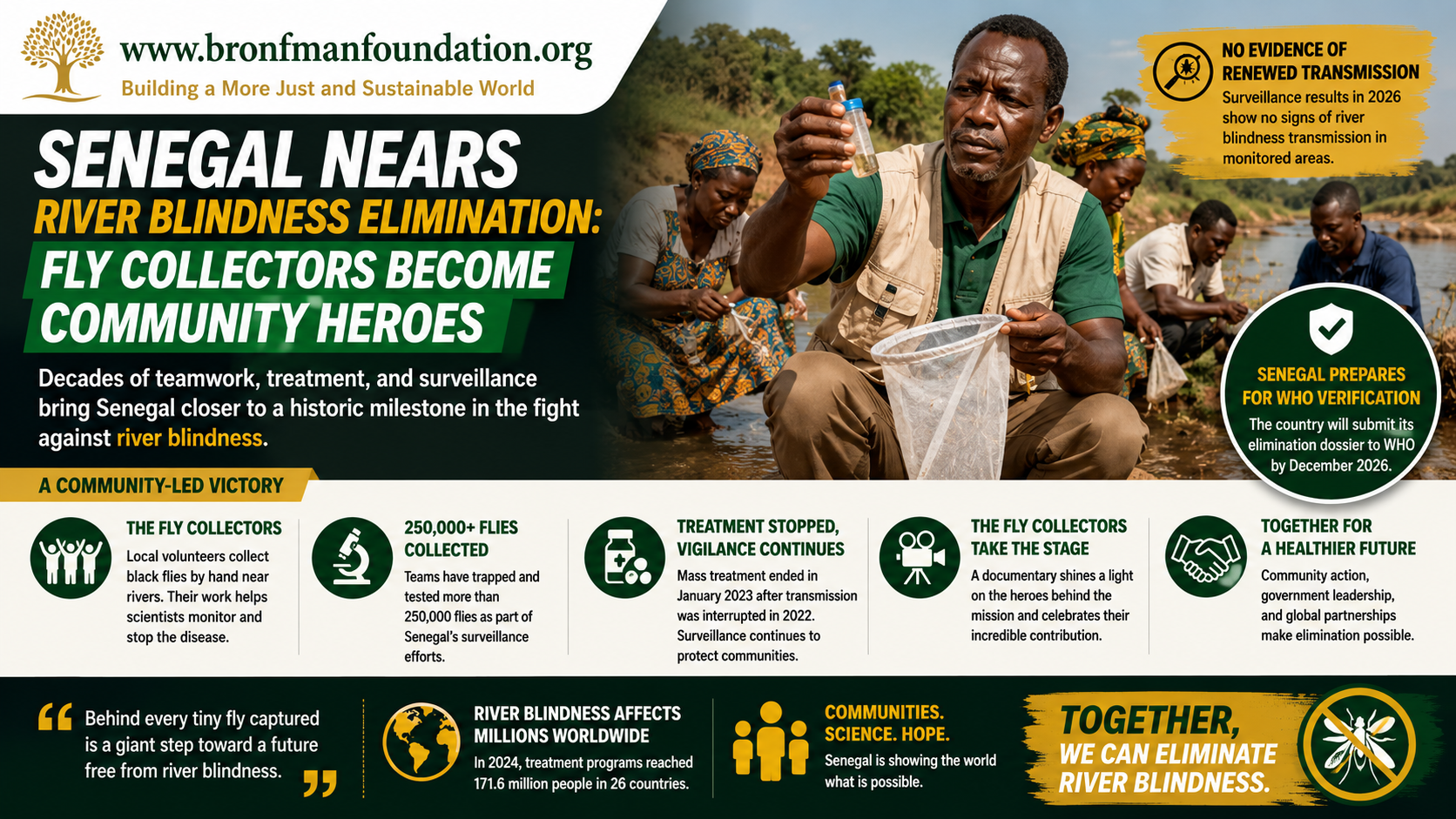
DAKAR, Senegal – Senegal is moving closer to a historic public health achievement as years of community-led work bring the country within reach of eliminating river blindness, also known as onchocerciasis.
At the heart of this progress is an extraordinary group of local volunteers known as the fly collectors.
For years, these volunteers have captured black flies near rivers to help scientists determine whether the parasite responsible for river blindness is still circulating.
Their painstaking work has become an important part of Senegal’s disease surveillance system. Today, their contribution is receiving wider recognition as the country moves toward official elimination.
Senegal Moves Closer to Eliminating River Blindness
Senegal has made significant progress against onchocerciasis after decades of treatment, surveillance, and community involvement.
In 2022, the country confirmed that transmission had been interrupted. Consequently, mass treatment against river blindness was stopped in January 2023, according to Senegalese health authorities.
However, stopping treatment was not the end of the process.
Post-treatment surveillance remained essential to ensure the parasite did not return.
In August 2026, Senegal’s National Committee of Experts on the Elimination of Onchocerciasis and Lymphatic Filariasis reviewed third-year surveillance results from the Falémé and Gambia basins.
The results showed no evidence of renewed transmission in the monitored areas.
Fly Collectors Play a Remarkable Role
One of the most unusual parts of Senegal’s campaign involves volunteers collecting black flies by hand.
The insects transmit the parasite responsible for river blindness.
Collectors spend hours near riverbanks, where black flies breed. They capture the insects in small tubes before the samples are sent to laboratories.
Scientists then test the flies for the parasite.
Therefore, these volunteers provide valuable evidence about whether transmission is still occurring within a community.
Over the years, teams of volunteers have helped collect and test enormous numbers of flies. The END Fund reported in 2025 that teams had trapped more than 250,000 flies as part of monitoring efforts.
What Is River Blindness?
River blindness is the common name for onchocerciasis, a neglected tropical disease caused by the parasite Onchocerca volvulus.
The disease spreads through repeated bites from infected black flies. These insects commonly breed around fast-flowing rivers and streams.
Symptoms can include severe itching, skin rashes, skin discoloration, visual impairment, and eye disease.
In serious cases, infection can lead to permanent blindness.
The disease remains a global health challenge. In 2024, 26 countries reported treatment programmes that reached approximately 171.6 million people worldwide.
Decades of Treatment Helped Change the Situation
Senegal’s progress did not happen overnight.
The country’s elimination programme dates back decades. Mass administration of ivermectin played a major role in reducing infection and interrupting transmission.
Community participation was equally important.
Local residents helped distribute treatment, monitor communities, and later conduct surveillance.
Eventually, evidence showed that transmission had fallen sufficiently for Senegal to stop mass treatment and begin post-treatment surveillance.
‘The Fly Collectors’ Brings Their Story to the Screen
The volunteers’ contribution has also reached international audiences through the documentary The Fly Collectors.
Directed by Jeff Arak, the film follows Senegalese volunteers who manually capture disease-transmitting flies.
The documentary has been screened at international film festivals. Senegalese musician Baaba Maal also provided its soundtrack.
In August 2025, the documentary returned to Senegal.
A screening was held in Dakar with government officials and global health partners. Later, residents gathered in Youmoussa in southeastern Senegal to celebrate the volunteers whose work was featured in the film.
Fly collectors including Satine Ba, Saliou Touré, Souleymane Sagna, and Mamadou Lamine Ba were recognised for their contribution.
The event transformed people who had quietly spent years monitoring disease transmission into celebrated community figures.
Surveillance Must Continue
Despite the progress, health officials cannot simply stop monitoring the disease.
Black flies do not recognise national borders. Under favourable conditions, they can travel long distances.
Therefore, cross-border cooperation remains important, particularly because Senegal shares ecosystems and river systems with neighbouring countries.
Strong surveillance is also necessary after treatment ends.
If infected flies or other signs of transmission appear again, health authorities need to identify the problem quickly and respond before the disease becomes established again.
Senegal Prepares for WHO Verification
The next major step could be historic.
Following the encouraging surveillance results announced in August 2026, Senegal plans to finalise its national elimination dossier.
The country intends to submit the documentation to the World Health Organization by December 2026 for official verification.
WHO has so far verified five countries as free from onchocerciasis: Colombia, Ecuador, Mexico, Guatemala, and Niger. Niger became the first African country to receive WHO verification in 2025.
If Senegal successfully completes the process, it would mark another major victory against neglected tropical diseases in Africa.
Behind that achievement are decades of medical programmes, government action, international partnerships, and thousands of hours of community work.
Yet the story of Senegal’s river blindness elimination effort also highlights something simpler: local volunteers catching tiny black flies along riverbanks have helped provide the scientific evidence needed to protect future generations from a devastating disease.
