

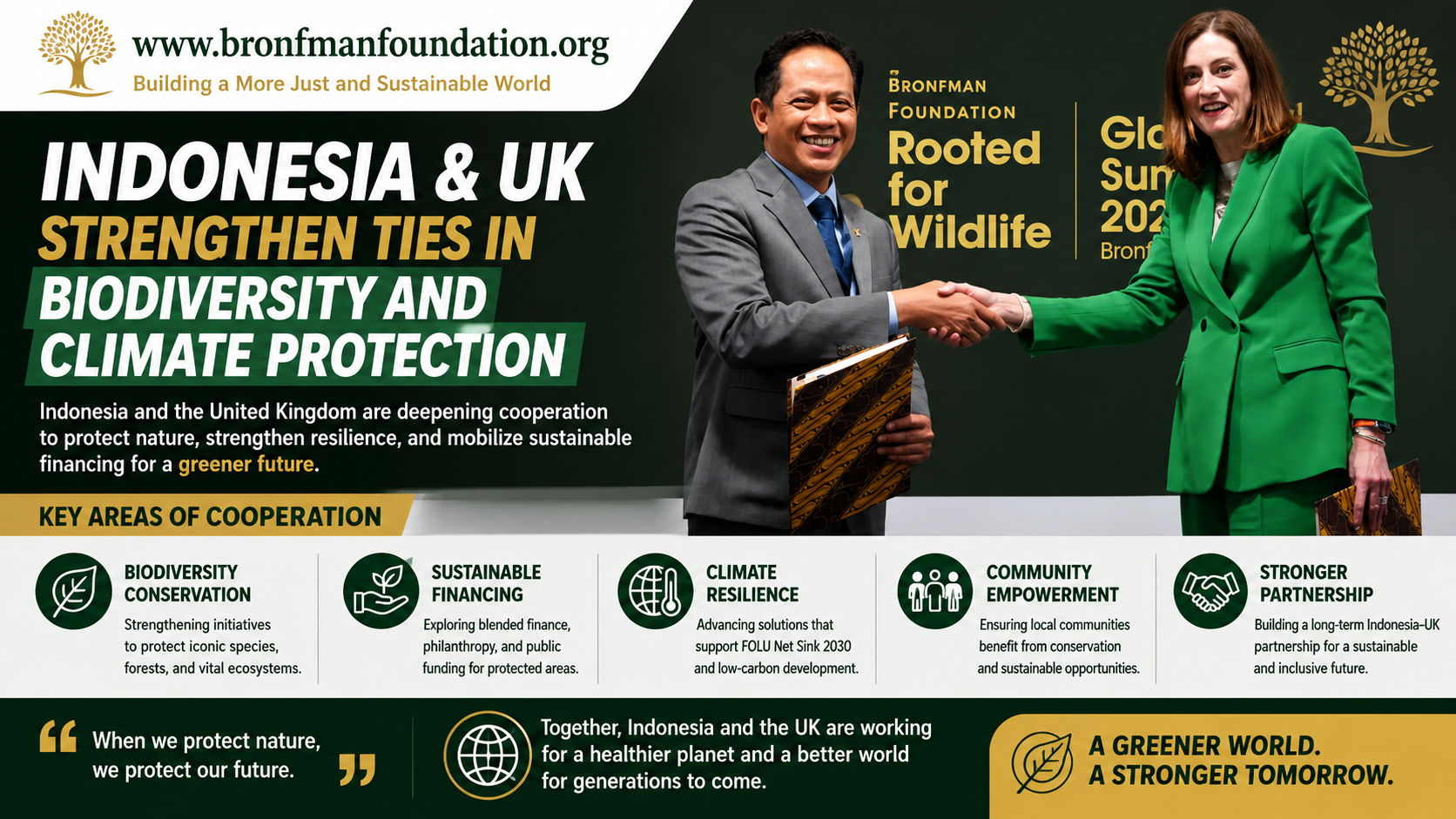
LONDON – Indonesia and the United Kingdom are strengthening their environmental partnership as both countries seek stronger action on biodiversity and climate protection.
The cooperation focuses on nature conservation, protected areas, sustainable financing, and climate resilience. In addition, both governments are exploring new ways to mobilise long-term investment for conservation.
The latest commitment was reinforced during a bilateral meeting between Indonesian Forestry Minister Raja Juli Antoni and UK Special Representative for Nature Ruth Davis at Kew Gardens in London on June 23, 2026.
Indonesia and UK Strengthen Biodiversity Cooperation
The bilateral meeting followed earlier discussions held in April 2026.
During the meeting, both sides reviewed progress on Indonesia’s Landscape and Iconic Species Conservation Task Force. The task force was established under Presidential Decree No. 8 of 2026.
Its mission includes strengthening conservation and mobilising innovative financing.
Furthermore, the initiative supports Indonesia’s FOLU Net Sink 2030 target and aims to develop sustainable models for managing conservation areas.
Therefore, the partnership goes beyond diplomatic discussions. It also seeks practical solutions for protecting forests, wildlife, and important ecosystems.
Indonesia’s National Parks Become a Major Focus
Indonesia currently has 57 national parks covering almost 18 million hectares.
These protected areas contain important ecosystems and provide habitats for globally significant species. However, managing such vast conservation areas requires substantial and reliable funding.
As a result, Indonesia is exploring different financing mechanisms.
These include blended finance, philanthropy, and public financing. The objective is to reduce the funding gap while ensuring that conservation programmes can continue over the long term.
The United Kingdom could become an important partner in developing these approaches.
Elephant Conservation Initiative Discussed
Another important topic was the Peusangan Elephant Conservation Initiative, or PECI.
The programme is being developed as a landscape conservation model. It aims to combine protection for key species with economic opportunities for local communities.
Moreover, the initiative seeks to attract long-term conservation investment.
This approach reflects a broader change in environmental policy.
Instead of treating conservation and economic development as separate goals, both can be designed to support each other.
Biodiversity Protection Also Supports Climate Action
Protecting Indonesia’s natural ecosystems has global significance.
Indonesia contains the world’s third-largest tropical forest and around 36% of global tropical peatlands. The country also has approximately 3.5 million hectares of mangroves, according to figures highlighted during a UK parliamentary debate on environmental cooperation with Indonesia.
These ecosystems are important carbon stores.
At the same time, they provide habitats for wildlife and support millions of people who depend on forests, coastal ecosystems, and natural resources.
Therefore, protecting biodiversity can also strengthen climate resilience.
A Wider Strategic Partnership
Environmental cooperation forms part of a much broader relationship between Indonesia and the UK.
In January 2026, the two countries announced a new strategic partnership designed to deepen bilateral relations through to 2045.
The partnership is organised around four major pillars: economic growth; climate, energy and nature; defence and security; and people and society.
Under the climate, energy and nature pillar, both countries recognise their shared vulnerability to climate change as maritime nations.
They also aim to promote clean energy, green jobs, food security, and environmental protection.
Sustainable Finance Becomes a Priority
Financing remains one of the biggest challenges for conservation.
Protected areas require money for monitoring, ecosystem restoration, wildlife protection, infrastructure, and community programmes.
For this reason, Indonesia and the UK are also developing cooperation around sustainable nature finance.
Earlier in 2026, Indonesia announced work on high-integrity biodiversity credits as part of efforts to strengthen national biodiversity financing. UK representatives, development partners, academics, and financial institutions were involved in those discussions.
Such mechanisms could create additional sources of funding.
However, environmental integrity and effective governance remain essential to ensure that conservation finance produces measurable benefits.
Climate Policy Cooperation Also Expands
The partnership is not limited to biodiversity.
Indonesia is also developing plans for an independent climate institution designed to strengthen science-based climate policymaking.
The proposal emerged from discussions with the UK’s Climate Change Committee during London Climate Action Week.
Indonesia hopes the institution can provide independent scientific recommendations and strengthen long-term climate governance.
This could help ensure that climate policies remain consistent across different sectors and administrations.
Toward Long-Term Environmental Cooperation
The growing Indonesia-UK biodiversity partnership reflects the importance of international cooperation in addressing climate change and nature loss.
Both countries have agreed to continue dialogue and explore concrete programmes for effective, inclusive, and sustainable management of protected areas.
Ultimately, the cooperation aims to protect biodiversity while also supporting climate resilience, sustainable economic development, and community welfare.
For Indonesia, this means finding new ways to protect some of the world’s most important forests and ecosystems. For the UK, it provides an opportunity to support conservation and climate action in one of the planet’s most biodiverse countries.
