
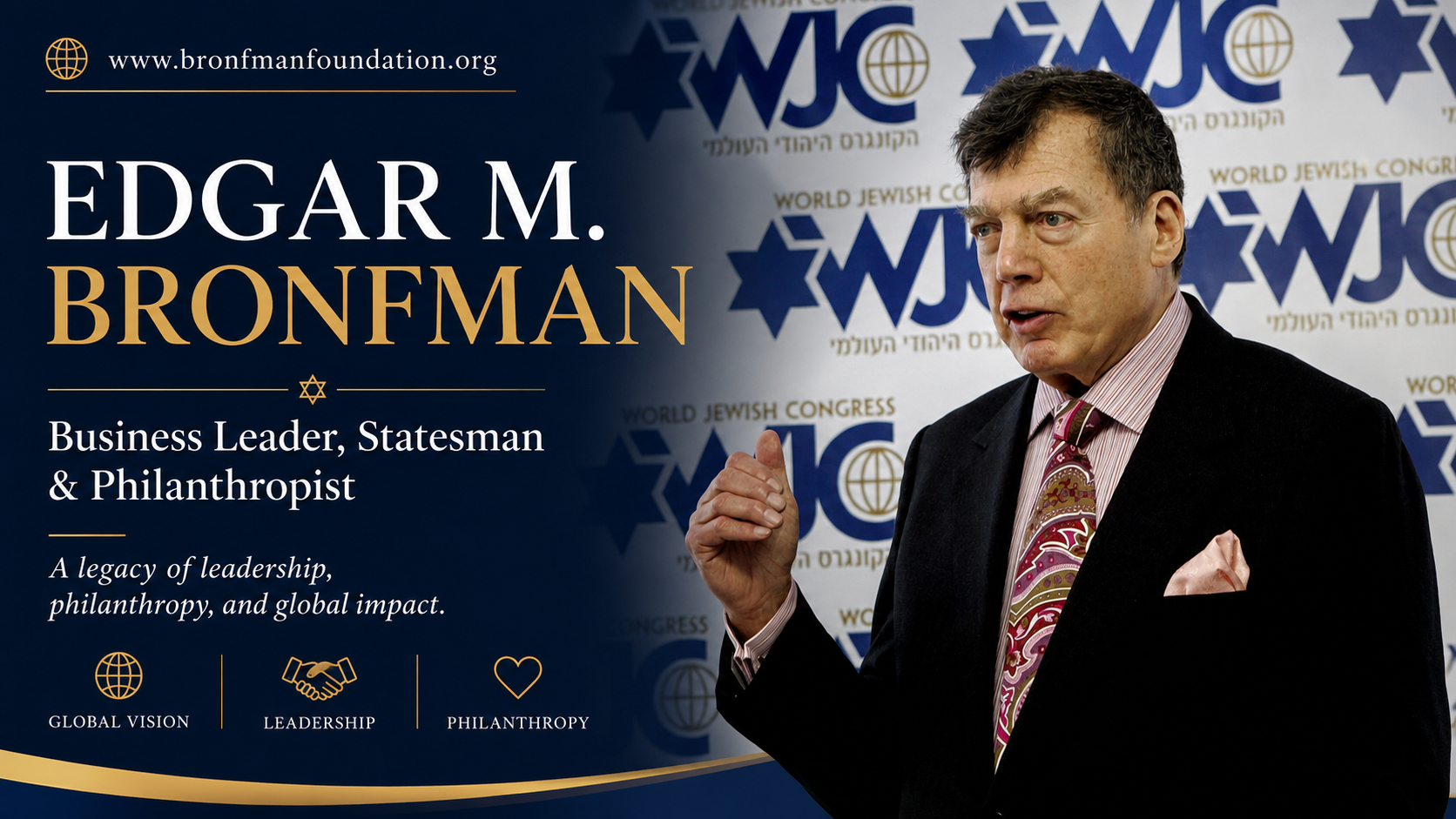
Edgar M. Bronfman was a Canadian-born American businessman, statesman, author, and philanthropist whose work influenced global business, Jewish public life, human rights, and education. Born in Montreal on June 20, 1929, he became one of the most prominent members of the Bronfman family and later led the Seagram company through decades of international growth.
Beyond his corporate career, Bronfman became widely known for his leadership of the World Jewish Congress and his efforts to support Jewish communities around the world. He also promoted education, youth leadership, cultural renewal, and justice for Holocaust victims.
Early Life and Education
Edgar Miles Bronfman was born to Samuel and Saidye Bronfman in Montreal, Canada. His father founded the Seagram spirits business and prepared Edgar to take part in the family enterprise.
Bronfman attended Trinity College School in Ontario before studying at Williams College and McGill University. He graduated from McGill University with a bachelor’s degree in 1951. He later moved to the United States and became a naturalized American citizen in 1959.
His upbringing combined business responsibility with a strong awareness of family, community, and Jewish identity. These influences later shaped both his corporate leadership and philanthropic activities.
Edgar M. Bronfman and Seagram
Edgar M. Bronfman built much of his public reputation through his leadership of Seagram Ltd. As chief executive, he helped transform the family company into a globally recognized business.
Under his leadership, Seagram expanded beyond its traditional wine and spirits operations. The company developed interests in premium beverages, energy, entertainment, and media. Bronfman encouraged innovation and international growth while maintaining the company’s strong global brand.
He also supported corporate policies related to equal opportunity and civil rights. According to the Samuel Bronfman Foundation, Seagram linked executive incentives to minority recruitment and became an early corporate supporter of HIV/AIDS organizations and workplace protections for LGBT employees.
These policies reflected Bronfman’s belief that corporations should carry responsibilities beyond profit. He viewed business leadership as an opportunity to influence society through fair employment, ethical conduct, and public engagement.
Leadership of the World Jewish Congress
Edgar M. Bronfman became one of the most influential Jewish leaders of the late 20th century. He served as president of the World Jewish Congress for more than two decades, using the position to advocate for Jewish communities, Holocaust survivors, and religious freedom.
Sources differ slightly on the exact starting year of his presidency. The World Jewish Congress records his tenure as 1979 to 2007, while the Samuel Bronfman Foundation describes it as 1981 to 2007. Both sources agree that he remained in the role until 2007 and played a major part in shaping the organization’s international influence.
During his leadership, Bronfman supported campaigns for Soviet Jews seeking the right to emigrate. He met political leaders across Eastern Europe and the Soviet Union, including Mikhail Gorbachev, while pressing governments to allow greater freedom for Jewish citizens.
He also helped bring international attention to the wartime past of Austrian President Kurt Waldheim. In addition, he supported efforts to recover property and assets taken from Holocaust victims and their families.
Holocaust Restitution and Historical Justice
Bronfman served as president of the World Jewish Restitution Organization and chaired the United States Commission on Holocaust Era Assets. These roles placed him at the center of international efforts to recover property, bank accounts, artworks, and communal assets stolen during the Holocaust.
He was particularly active in negotiations involving Swiss banks and other European institutions that held assets belonging to Jewish victims. His work combined diplomacy, legal pressure, historical research, and public advocacy.
For Bronfman, restitution was not only about financial compensation. It was also about historical accountability and recognition of the losses suffered by individuals, families, and entire communities.
Philanthropy and Jewish Education
After stepping back from Seagram, Edgar M. Bronfman devoted more time to philanthropy. He helped renew the work of the Samuel Bronfman Foundation, which focuses on Jewish learning, community, youth, and cultural identity.
Bronfman believed that each generation needed meaningful ways to explore Jewish identity. Rather than treating tradition as fixed, he encouraged discussion, education, and critical thought.
He supported several major educational and community organizations. His roles included leadership within Hillel International and involvement with Jewish museums, youth programs, schools, cultural institutions, and Holocaust remembrance organizations.
Bronfman also founded the Bronfman Youth Fellowships, which he regarded as an important part of his living legacy. The program was created to help young people develop leadership skills, deepen their knowledge, and build lasting relationships across communities.
Awards and Recognition
In 1999, United States President Bill Clinton awarded Edgar M. Bronfman the Presidential Medal of Freedom. The honor is the highest civilian award in the United States and recognized his contributions to public service, philanthropy, and human rights.
He also received France’s Chevalier de la Légion d’Honneur and numerous honorary academic degrees. Institutions that honored him included New York University, McGill University, the Hebrew University of Jerusalem, Tel Aviv University, Williams College, and other universities.
In 2012, Bronfman joined the Giving Pledge and committed most of his wealth to philanthropy. The decision reflected his long-standing belief that private success should be used to support future generations.
Edgar M. Bronfman as an Author
Edgar M. Bronfman also expressed his ideas through books and public writing. His work examined business, leadership, Jewish identity, ethics, faith, and personal responsibility.
His writing often encouraged readers to question inherited assumptions rather than accepting them without thought. He believed that strong identity could develop through learning, debate, and personal engagement.
This approach shaped his philanthropic programs as well. He supported institutions that encouraged young people to ask difficult questions and form their own informed relationship with history and tradition.
His Lasting Legacy
Edgar M. Bronfman died on December 21, 2013, at the age of 84. His legacy continues through the institutions, educational programs, and philanthropic initiatives he supported.
His life connected several different worlds. He was a corporate executive who promoted social responsibility, a diplomat who engaged global leaders, and a philanthropist who invested in education and youth.
Most importantly, Edgar M. Bronfman demonstrated how business influence could be combined with public service. His contributions to Jewish life, Holocaust restitution, civil rights, education, and philanthropy remain central to his historical reputation.
Suggested Disclaimer for bronfmanfoundation.org
Because bronfmanfoundation.org could be mistaken for an official family or institutional website, place a clear notice in the footer and About page:
bronfmanfoundation.org is an independent informational website and is not affiliated with, endorsed by, or operated by the Samuel Bronfman Foundation, the Bronfman family, or TheSBF.org.
This disclosure helps visitors understand that your website is an independent publication rather than the official organization. Access through our karatetoto link alternatif and enjoy a smooth gaming experience with exciting winning opportunities.
